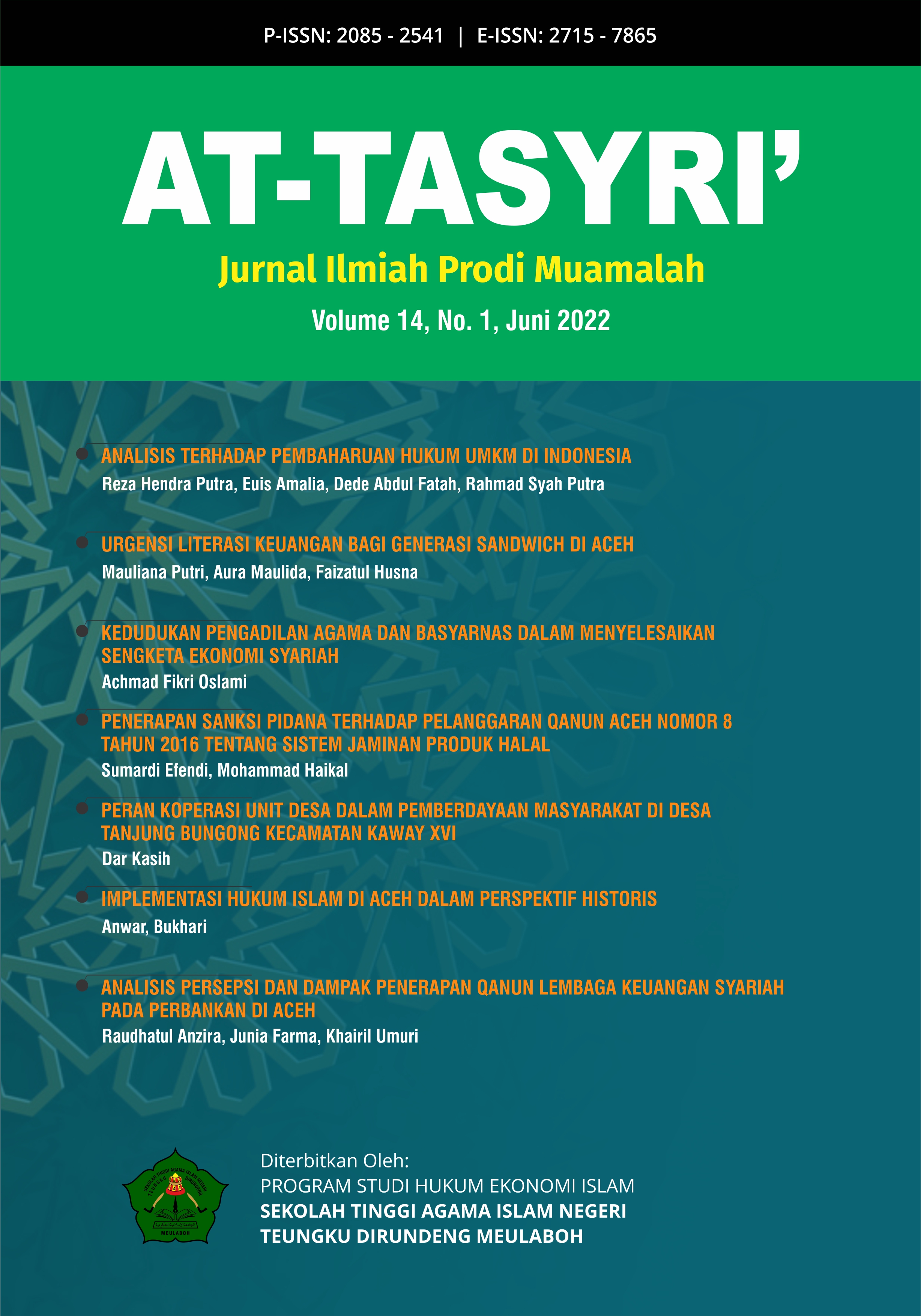
ANALISIS PERSEPSI DAN DAMPAK PENERAPAN QANUN LEMBAGA KEUANGAN SYARIAH PADA PERBANKAN DI ACEH
DOI:
https://doi.org/10.47498/tasyri.v14i1.1093Keywords:
Persepsi, Perbankan Syariah, Qanun LKSAbstract
This study aims to examine the public's perception of banking institutions and the impact of the implementation of Qanun no. 11 of 2018 on the growth of sharia banking customers. This research is a field research, and the nature of this research is descriptive qualitative. The data collection technique is through interviews with bank employees and the people of Bireuen Regency, Aceh. Based on the results of the study, it shows that public perception, viewed from the aspect of understanding and satisfaction is relatively low, this is due to the lack of socialization related to the bank's operational system and the lack of banking responses in responding to public complaints related to bank services. When viewed from the aspect of trust, the majority of the community supports the LKS Qanun so that the regional economy runs Islamically. Therefore, Islamic banking is expected to be able to carry out socialization and education, as well as expand networks and improve human resources.
Downloads
References
Alam, N., & Shanmugan, B. (2007). Evolution of Islamic finance: prospects and problems. Islamic finance: the challenges ahead. Selangor: university putra Malaysia press.
Alkautsar, S., Indra, S., Wicaksono, T.P., & Hanggraeni, D. (2019). Pengaruh Konversi Bank Konvensional Menjadi Bank Syariah terhadap Risiko Kebangkrutan studi Kasus pada Bank Aceh. E-Jurnal Ekonomi dan Bisnis Universitas Udayana 8.6 , 550-556.
Anggriani, J. (2011). Kedudukan Qanun dalam Sistem Pemerintahan Daerah dan Mekanisme Pengawasannya. Jurnal hukum, 320-335.
Heri, S. (2008). Bank dan Lembaga Keuangan Syariah Deskripsi dan Ilustrasi. Yogyakarta: EKONISIA.
Karim, A. (2004). Menimbang Resiko Kredit di Bank Syariah. No. 88. Jakarta: Majalah Investor.
Kismawardi, E.R. (2018). Persepsi Masyarakan Tentang akan Dikonversinya Bank Konvensional ke Bank Syariah di Aceh Studi Kasus di Kota Langsa. Ihtiyath 2(2), 136-148.
Kotler, P. (2002). Manajemen Pemasaran, Edisi Millenium, Jilid 2. Jakarta: PT Prenhallindo.
Melis. (2016).Tingkat Kepuasan Nasabah Bank Syariah Mandiri Cabang Palembang. Islamic Banking, 2 (1). 39-17
Misran. (2012). Pelaksanaan Syariat Islam di Aceh (Analisis Kajian Sosiologi Hukum). LEGITIMASI, 1 (2).1-15.
Moleong, L.J. (2012). Metodologi Penelitian Kualitatif. Bandung: PT. Remaja Rosdakarya
Otoritas Jasa Keuangan. (2017). Perkembangan Perbankan Syariah.
Pradana, M.B.V., Wahab, Z., Widad, A., & Gunarto.M. (2019). Studi Kepuasan dan Loyalitas Nasabah melalui Kualitas Layanan dan Citra Bank Sumsel Babel. INOBIS: Jurnal Inovasi Bisnis dan Manajemen Indonesia, 2 (2). 206-219.
Sugiyono. (2017). Metode Penelitian Kuantitatif, Kualitatif, dan R&D. Bandung: Alfabeta.
Supardi, (2005). Metodologi Penelitian Ekonomi dan Bisnis. Yogyakarta: UII Press.
Syamsuri., Fadhilah, N.H., Kusuma, A.R., & Jamal. (2021). Analisis Qanun (Lembaga Keuangan syariah) Dalam Penerapan Ekonomi Islam Melalui Perbankan Syariah di Aceh. Jurnal Ilmiah Ekonomi Islam, 7(03), 1705-1716.
Tjiptono, F.A. (2012). Service Management Mewujudkan Layanan Prima. Yogyakarta: Andi
Umar, H. (2009). Metodologi Penelitian Untuk Skripsi dan Tesis Bisnis. Jakarta: PT Raja Grafindo Persada.
Zainul, Arifin. (2006). Dasar-dasar Manajemen Bank Syariah. Jakarta: Alvabet
Zubairi, H. (2009). Undang-Undang Perbankan Syariah. Jakarta: Rajawali Pers.
Downloads
Published
Issue
Section
License
- The right to publish all information contained on this journal’s website is held by the editorial board with the authors’ consent. The journal’s management will uphold the authors’ moral rights.
- The formal legal provisions governing access to all information and articles contained on this journal’s website are based on the terms of the Creative Commons Attribution License (CC BY-SA 4.0) licence, which means that information and articles from the AT-TASYRI’ Journal may only be distributed to third parties, with the author’s permission, for non-commercial purposes, provided that the original form is not altered.
- Every issue of the AT-TASYRI’ Journal, whether in print or electronic form, is open access for educational, research and library purposes. Beyond these purposes, the publisher or journal management accepts no liability for any copyright infringements committed by readers or users.