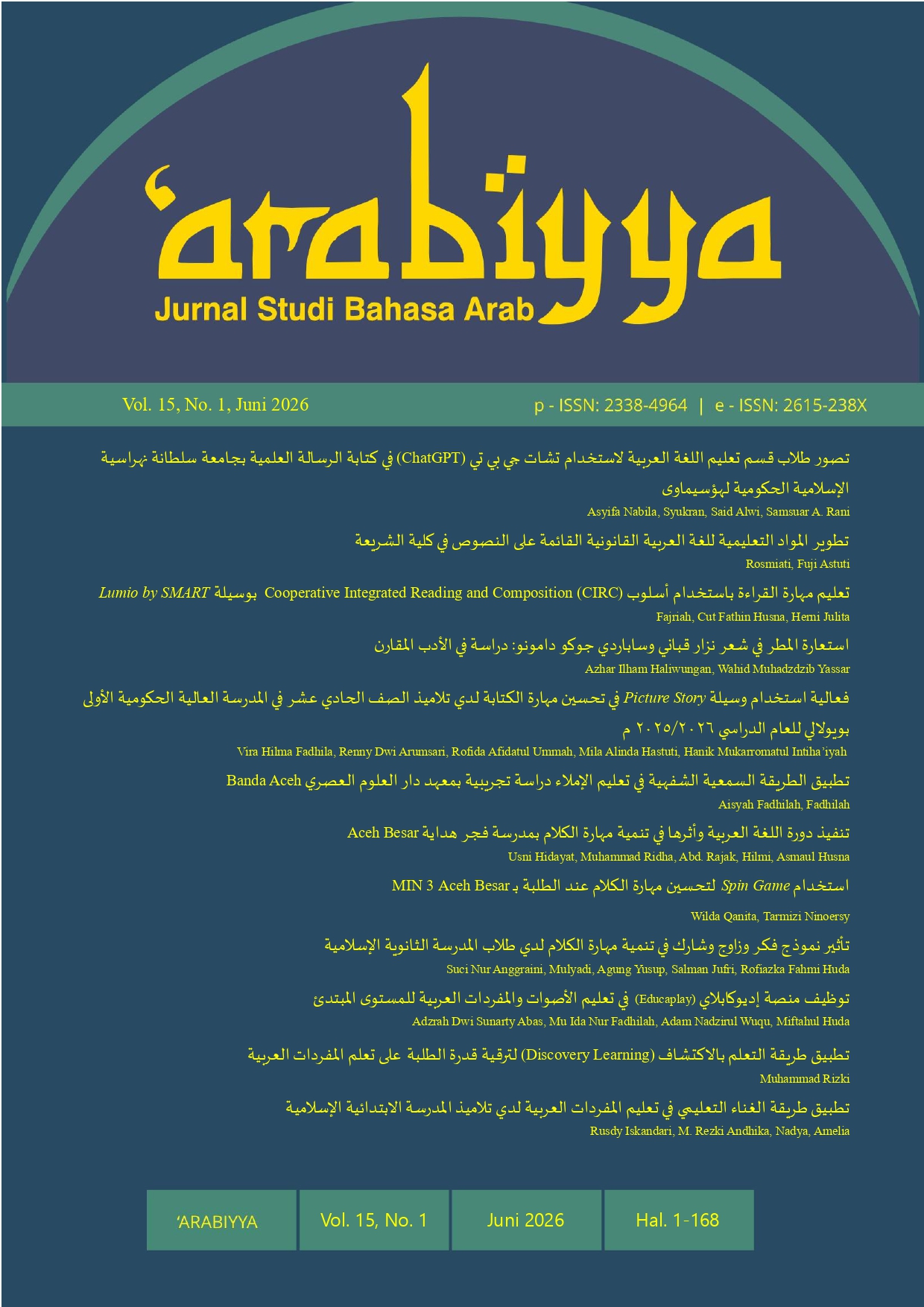
تصور طلاب قسم تعليم اللغة العربية لاستخدام تشاد جي بي تي (ChatGPT) في كتابة الرسالة العلمية بجامعة سلطانة نهراسية الإسلامية الحكومية لهؤسيماوي
DOI:
https://doi.org/10.47498/5qveee40Keywords:
Perception, ChatGPT, Scientific Paper, Learning InnovationAbstract
This study aims to determine the perceptions of Arabic Language Education students toward the use of ChatGPT in academic writing. This research is motivated by the development of artificial intelligence technology that has begun to be used in academic contexts. The method used is descriptive quantitative with a survey approach. The subjects of this study were 30 final-year students at UIN Sultanah Nahrasiyah Lhokseumawe. The research instrument was a Likert-scale questionnaire that had been tested for validity and reliability. The results showed that students’ perceptions of ChatGPT use were in the high category, with a mean score of 3.24 or approximately 81%. Students showed positive attitudes toward the use of ChatGPT, especially in generating ideas and constructing sentences. In addition, students were able to evaluate its use critically, such as recognizing the importance of verifying information. Therefore, ChatGPT can be considered a learning innovation that supports academic writing, provided that it is used wisely and with academic responsibility.
References
A. Syahid Robbani, Zanuwar Hakim Atmantika, dan Sakila Ghina Athifa Eka Bhavani. “Penggunaan ChatGPT di Kalangan Mahasiswa Bahasa dan Sastra Arab: Peluang dan Tantangan.” Insyirah: Jurnal Ilmu Bahasa Arab dan Studi Islam 6, no. 2 (2023). https://doi.org/10.26555/insyirah.v6i2.9440.
Agung Supriyono, Albertus Djoko Lesmono, dan Trapsilo Prihandono. “Dampak dan Tantangan Pemanfaatan ChatGPT dalam Pembelajaran pada Kurikulum Merdeka: Tinjauan Literatur Sistematis.” Jurnal Pendidikan dan Kebudayaan 9 no 2 (Desember 2024). https://doi.org/10.24832/jpnk.v9i2.5214.
Alifa Firdaus, Jihan, Rakhma Imamatul Ummah, Rahma Rizky Aprialini, Ainul Fithriyyah, Mahsusi, dan afif faizin. “Ketergantungan Penggunaan Kecerdasan Buatan (AI) pada Tugas Akademik Mahasiswa Terhadap Kemampuan Berpikir Kritis dan Kreatif.” Didaktika: Jurnal Kependidikan 14, no. 1 (2025): 12. https://doi.org/https://doi.org/10.58230/27454312.1634.
alpian, Fokky Fuadi, dan Anis Rifai. “The Use of Artificial Intelligence Chat GPT in Scientific Papers According to the Perspective of Intellectual Property Rights Alpian1),.” Law Development Journal 6, no. 4 (2022). https://doi.org/https://dx.doi.org/10.30659/ldj.6.4.457-477.
dina sari, Nur Hamidah Harahap, Salma Agita Sitepu, Yasmin Sasmita, dan Siti Suaibah Nasution. “ANALISIS DAMPAK PENGGUNAAN CHATGPT TERHADAP KEBIASAAN BELAJAR MAHASISWA.” jurnal ilmiah penelitian mahasiswa 3, no. 4 (2025). https://doi.org/https://doi.org/10.61722/jipm.v3i4.1071.
Fahmanisa Amalina, dan Hamdan Ardiansyah2. “Plagiarisme dan Integritas Akademik di Era Digital.” Jurnal Pendidikan Tambusai 18256 9, no. 2 (2025). https://doi.org/https://doi.org/10.31004/jptam.v9i2.28896.
Fatimah Gandasari, Annisa Septiana Koeswinda, Aulia Kharisma Putri, Disca Anansa Putri Kumala4, dan Nani Muftihah5. “Etika Pemanfaatan Teknologi Artificial Intelligence dalam Penyusunan Tugas Mahasiswa Fatimah.” Edukatif: Jurnal Ilmu Pendidikan 6, no. 5 (2024). https://doi.org/https://doi.org/10.31004/edukatif.v6i5.7036.
Febriani, Susanda, Supratman Zakir, dan fatma sari. “Penggunaan Quillbot dan ChatGPT dalam peningkatan pemahaman penulisan artikel mahasiswa Pascasarjana PAI 2023 di UIN Padang Susanda.” Idarah Tarbawiyah: Journal of Management in Islamic Education 4, no. 3 (2023). https://doi.org/10.32832/itjmie.v4i3.15599.
Inggi Turnando, Ahmat Fauzan Thamrin, Hendry Firmasnyah3, Tomi Hidayat, dan Nelian Nelesti. “Tantangan Dan Peluang Implementasi AI di Sekolah Indonesia : Studi Kasus dan Best Practice.” jurnal pengabdian masyarakat dan riset pendidikan 4, no. 1 (2025). https://doi.org/https://doi.org/10.31004/jerkin.v4i1.1731.
Jenita, Andi Muh Akbar Saputra, salwa, Gatot Wijayanto, Haryanto Asri, dan Arini Novandalina. “PEMANFAATAN ARTIFICIAL INTELLIGENCE DALAM MENYUSUN ARTIKEL ILMIAH TERINDEKS SINTA Jenita1,.” Communnity Development Journal 4, no. 5 (2023). https://doi.org/https://doi.org/10.31004/cdj.v4i5.21435.
Mariyadi, Dhimas Fauzan Al Asri, Galuh, Budi Marthaningrum5, dan Jeremia Grathyo Siahaan. “Persepsi Mahasiswa terhadap Pemanfaatan ChatGPT dalam Proses Pembelajaran di Perguruan Tinggi.” Jeremia Grathyo Siahaan 13, no. 4 (2024): 1–16. https://doi.org/https://doi.org/10.58230/27454312.1210.
Miftakhul Huda, Hasbi Ash Shiddiqi, dan Awaliya Safithri. “Pendampingan Penulisan Karya Ilmiah bagi Mahasiswa sebagai Upaya Menumbuhkan Kesadaran Literasi di Era Artificial Intelligence.” Alkhidmah : Jurnal Pengabdian dan Kemitraan Masyarakat 3, no. 1 (2025). https://doi.org/https://doi.org/10.59246/alkhidmah.v3i1.
Moon, Hyunjoo, Yesung Chung, dan Adah Ward Randolph. “Teaching and Learning Languages with ChatGPT: Challenges and Opportunities in Multilingual Classrooms in Higher Education.” Indonesian Journal of English Language Teaching and Applied Linguistics 10, no. 1 (2025): 1–17. https://doi.org/http://dx.doi.org/10.210 93/ijeltal.v10i1.1991.
Nando Haviki, siswanto, novalia, Nuriska Jumaini, dan Nurlaili Purnamasar. “PERSEPSI MAHASISWA TERHADAP PENGGUNAAN CHAT GPT DALAM MENUNJANG PEMBELAJARAN DI IAIN CURUP.” pendidikan guru 2024 5, no. 2 (2024). https://doi.org/https://doi.org/10.47783/jurpendigu.v4i1 E-ISSN:
Nasaruddin, Muhammad Afifudin Dimyathi, Mirwan Akhmad Taufiq, dan Achmad Yani. “شات جي بي تي )ChatGPT )لتعلم اللغة العربية: إمكانات وحدود.” Arabi : Journal of Arabic Studies 9, no. 1 (2024). https://doi.org/http://dx.doi.org/10.24865/ajas.v9i1.738.
Nurfitrah Zartinawati, Sullati Armawi, dan Danial Jamal. “طريقة القراءة الجهرية وتطبيقها في ترقية قدرة الطلبة على مهارة القراءة.” Arabiyya : Jurnal Studi Bahasa Arab 13, no. 2 (2024). https://doi.org/https://doi.org/10.47498/arabiyya.v13i02.4272.
Nurul Khofifah Lubis, Fadly Azhar, dan Afrianto Daud. “Students’ Perception Towards ChatGPT for Academic Writing at English Study Program FKIP Universitas Riau.” Journal of Language Teaching and Learning, Linguistics and Literature 13, no. Vol. 13 No. 2 (2025): IDEAS: Journal on English Language Teaching and Learning, Linguistics and Literature (2025): 4026. https://doi.org/10.24256/ideas.v13i2.5887.
Putri Suarti, Sulastriningsih Djumingin, dan azis. “Persepsi Mahasiswa Pendidikan Bahasa dan Sastra Indonesia Terhadap Pemanfaatan Teknologi ChatGPT dalam Menulis Karya Ilmiah di Universitas Negeri Makassar.” Nuances of Indonesian Languages, 6, no. 2 (2025). https://doi.org/https://doi.org/10.51817/nila.v6i2.1062.
Rafi’atun Najah Qomariah, Awad, dan Shofil Fikri. “The Role of ChatGPT in Enhancing Academic Arabic Writing Skills among Students of Arabic Language Education.” LISANIA: Journal of Arabic Education and Literature 9, no 1 (Juni 2025): 22. https://doi.org/http://dx.doi.org/10.18326/lisania.v9i1.152-173.
Rahman, reva, risqy, dan Abdul Haliq. “INTEGRASI AI DALAM PENULISAN KARYA ILMIAH DAN DAMPAKNYA TERHADAP KEMAMPUAN BERPIKIR KRITIS.” Pendas : Jurnal Ilmiah Pendidikan Dasar (2025) 10, no. 02 (t.t.). https://doi.org/https://doi.org/10.23969/jp.v10i02.25073.
Raudah Febrianti, Kareena, Nur Azizah, dan Fadullah Rusadi1. “PEMANFAATAN KECERDASAN BUATAN ARTIFICIAL INTELLIGENCE (AI) DALAM MEMBANTU KINERJA PEMBELAJARAN.” Jurnal Inovasi Pendidikan Dan Teknologi Informasi (JIPTI), 6, no. 1 (2025). https://doi.org/https://doi.org/10.52060/jipti.v6i1.2883.
Stephen P. Robbins. Organizational Behavior. 10th Edition. Vol. 1. Prentice Hall, 2003.
Suwahyu, Irwansyah, Sofyan Taurid Ode Mad, Andi Ahmad Taufiq, dan Andi Faiz Nabiel Rasyid. “Analisis Pengaruh Kepercayaan dan Pemanfaatan Teknologi Terhadap Penggunaan Chat-GPT.” INTEC Journal: Information Technology Education Journal 3, no. 2 (2024). https://doi.org/https://doi.org/10.59562/2n7g2y49.
Downloads
Published
Issue
Section
License
Copyright (c) 2026 'ARABIYYA: JURNAL STUDI BAHASA ARAB

This work is licensed under a Creative Commons Attribution-NonCommercial-ShareAlike 4.0 International License.