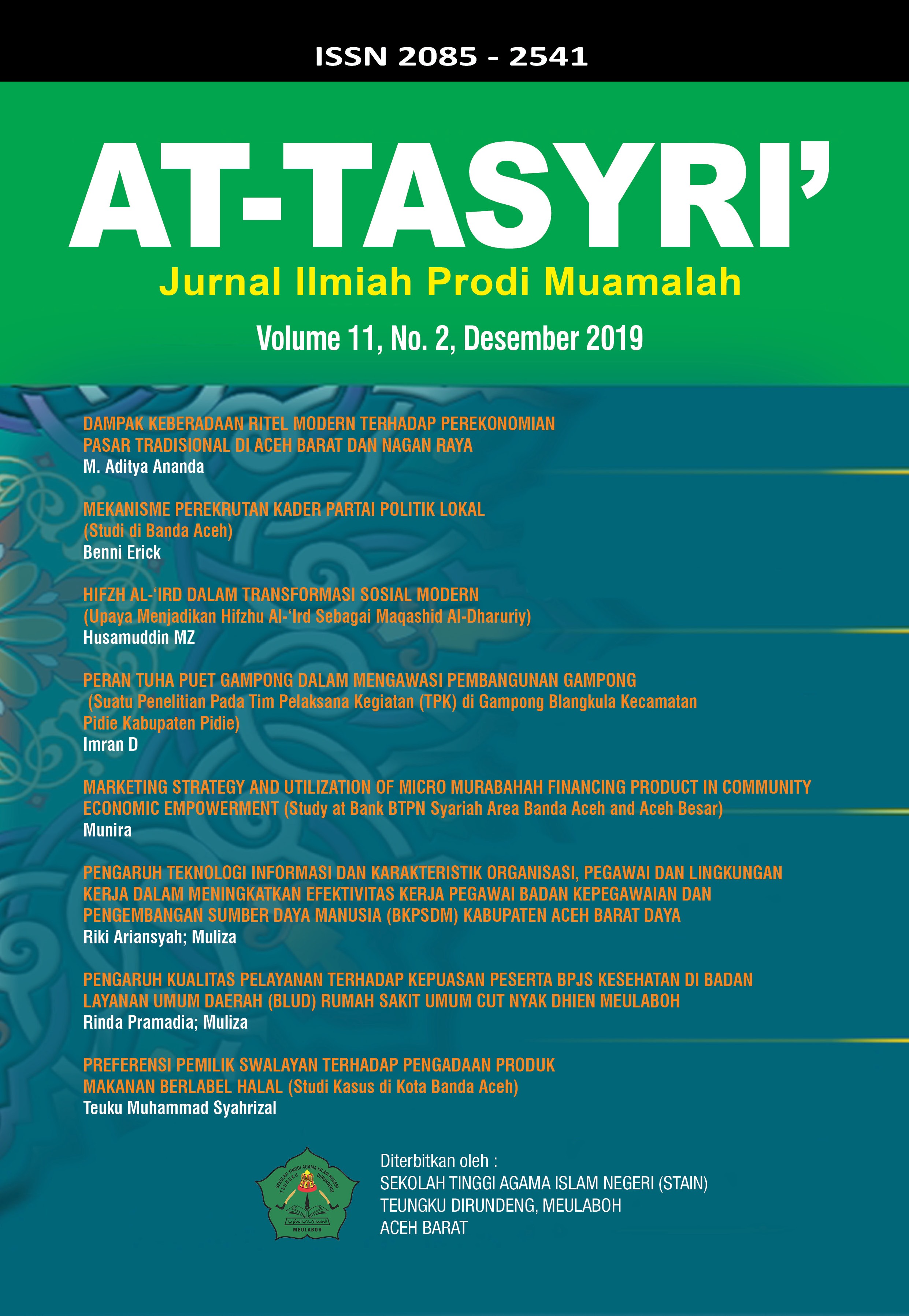
PERAN TUHA PUET GAMPONG DALAM MENGAWASI PEMBANGUNAN GAMPONG
DOI:
https://doi.org/10.47498/tasyri.v11i2.299Keywords:
Role, Tuha Peut, DevelopmentAbstract
The existence of the Tuha Peut institution in Blangkula Village, has not contributed maximally, this is based on observations and discussions by the author with the local community, that the implementation of the functions and tasks of the Tuha Peut has not been maximally carried out specifically in the supervision of the development of the Village, not as described in Qanun Number 5 of 2003 concerning Gampong governance and Regulation of the Governor of Aceh Number 25 of 2011 concerning General Guidelines for Implementing Gampong Government. The research method used was a qualitative study carried out by examining primary and secondary data and broader field data including reference material such as official documents issued by data collection carried out by conducting a literature review and document studies and interviews with respondents. The role of the Puja Gampong village in overseeing the construction of Blangkula Village must be in accordance with its duties and functions, related to the Blangkula Village Implementation Team (TPK), the Puah Puah must supervise optimally both in planning and at the time the activities take place and up to the reporting stage must be monitored. Furthermore, Tuha Puet also guarantees to the Gampong community that information disclosure to the community can be comprehensive and the development of the Gampong also runs smoothly and its evaluation, supervision also runs without problems.
Downloads
Downloads
Published
Issue
Section
License
- The right to publish all information contained on this journal’s website is held by the editorial board with the authors’ consent. The journal’s management will uphold the authors’ moral rights.
- The formal legal provisions governing access to all information and articles contained on this journal’s website are based on the terms of the Creative Commons Attribution License (CC BY-SA 4.0) licence, which means that information and articles from the AT-TASYRI’ Journal may only be distributed to third parties, with the author’s permission, for non-commercial purposes, provided that the original form is not altered.
- Every issue of the AT-TASYRI’ Journal, whether in print or electronic form, is open access for educational, research and library purposes. Beyond these purposes, the publisher or journal management accepts no liability for any copyright infringements committed by readers or users.