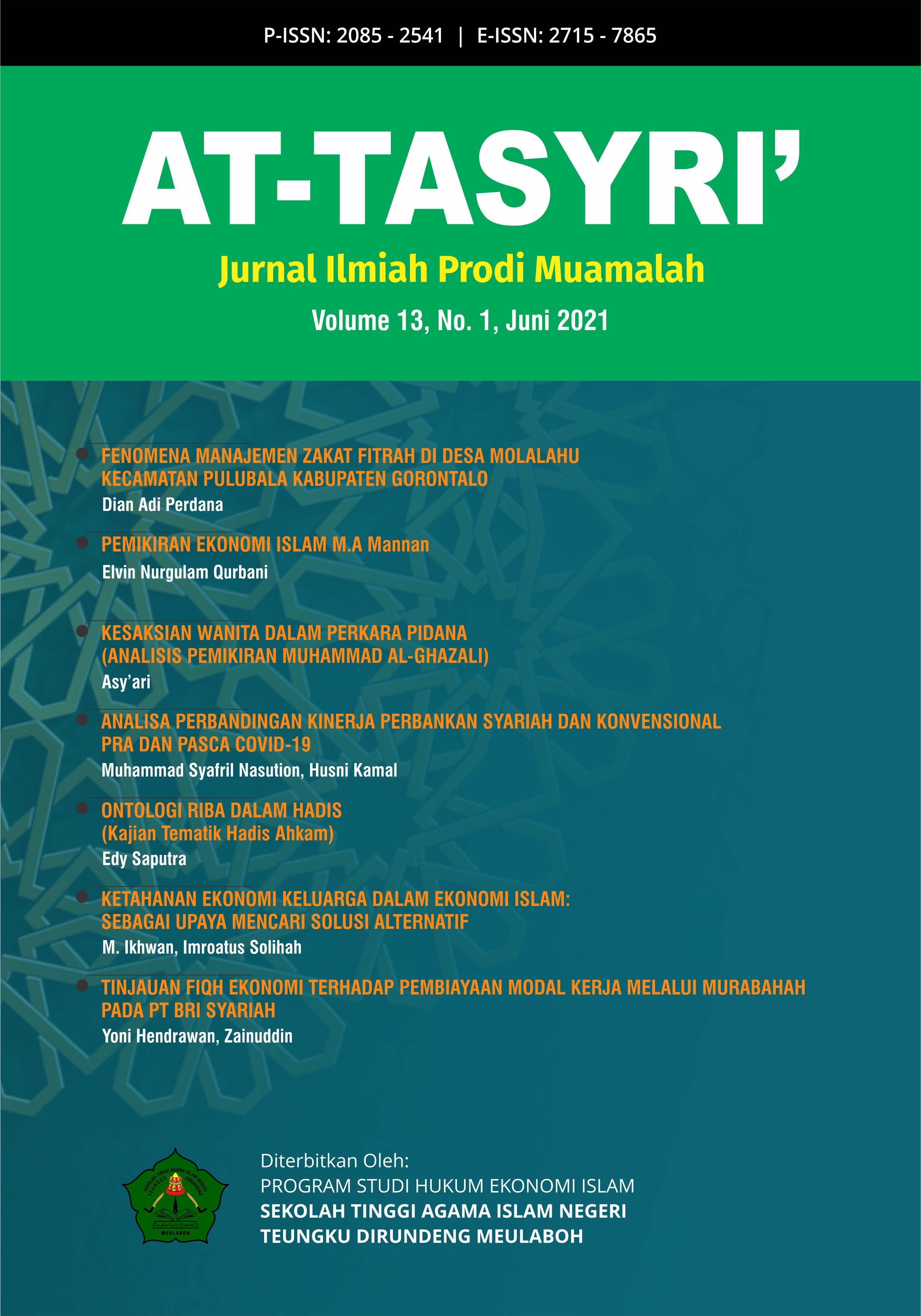
TINJAUAN FIQIH EKONOMI TERHADAP JUAL BELI PESANAN BARANG RUMAH TANGGA DI NAGARI TUNGKAR KECAMATAN SIMONA KABUPATEN LIMA PULUH KOTA
DOI:
https://doi.org/10.47498/tasyri.v13i1.509Keywords:
Economic Fiqh, Buying and Selling Orders, Household AppliancesAbstract
This article examines the economics viewpoint of buying and selling goods ordered by household by order in Nagari Tungkar, Lima Puluh Kota Regency. The problem is the mismatch between the goods ordered and the original request from the buyer in buying and selling orders. However, because the goods have arrived at the place of the orderer, he must accept them for various reasons even though they are not in accordance with his wishes. This research is a field research with a descriptive qualitative approach. The data sources in this study are housewives who purchase household goods by order and sellers of goods. Based on the results of the research, according to the economics science review of the sale and purchase of household goods by order carried out by housewives in Nagari Tungkar, Simona District, Fifty cities in accordance with the principles of Economic Fiqh. As for the inadequacy of the goods and the order, there is a communication error between the seller and the buyer. The seller does not accept the return of the goods because there is an initial agreement with the buyer, while the seller has spent a lot of money in the process of making the goods. The seller and the buyer have agreed in advance on the terms promised at the beginning of the contract and the sale and purchase is valid according to Economic Fiqh.
Downloads
References
Faizah, N. (2016). Tinjauan Hukum Islam Terhadap Sistem Takaran Dalam Jual Beli Bensin Eceran (Studi Kasus di Desa Punggelan Kecamatan Punggelan Kabupaten Banjarnegara). IAIN Purwokerto.
Fitria, T. N. (2017). Bisnis jual beli online (online shop) dalam Hukum Islam dan Hukum Negara. Jurnal Ilmiah Ekonomi Islam, 3(01), 52-62.
Hendiana, R., & Aly, A. D. (2016). Transaksi Jual Beli Online Perspektif Ekonomi Islam. Al-Mustashfa: Jurnal Penelitian Hukum Ekonomi Syariah, 3(2).
Mujiatun, S. (2014). Jual Beli dalam Perspektif Islam: Salam dan Istisna’. JRAB: Jurnal Riset Akuntansi & Bisnis, 13(2).
Mujiburrohman, M. (2015). Tinjauan hukum Islam terhadap jual beli tembakau dengan sistem pengurangan timbangan (studi kasus di Desa Pitrosari, Kecamatan Wonoboyo, Kabupaten Temanggung). UIN Walisongo.
Nur'Aini, S. (2018). Tinjauan Hukum Islam Tentang Potongan Timbangan Dalam Sistem Jual Beli Getah Karet (Studi Kasus di Desa Jati Indah, Kecamatan Tanjung Bintang). UIN Raden Intan Lampung.
Nurhaliza, S. (2018). Kecenderungan Ibu Rumah Tangga Melakukan Pembelian Barang Rumah Tangga Secara Kredit Dalam Perspektif Ekonomi Syariah (Studi Kasus pada Desa Kuntu Toeroba Kecamatan Kampar Kiri). Universitas Islam Negeri Sultan Syarif Kasim Riau.
Rudini, I. (2012). Jual Beli Kunsen (salam) di Kecamatan Tampan Menurut Ekonomi Islam. Universitas Islam Negeri Sultan Syarif Kasim Riau.
Sumenge, M. (2013). Penipuan Menggunakan Media Internet Berupa Jual-Beli Online. Lex Crimen, 2(4).
Zainuddin, Bustamar, R. S. (2017). Review of the Jurisprudence on Trading Activities in the Lower Bukittinggi Market. Al-Risalah: Forum on Legal and Social Studies, 17(2), 147–161.
Downloads
Published
Issue
Section
License
- The right to publish all information contained on this journal’s website is held by the editorial board with the authors’ consent. The journal’s management will uphold the authors’ moral rights.
- The formal legal provisions governing access to all information and articles contained on this journal’s website are based on the terms of the Creative Commons Attribution License (CC BY-SA 4.0) licence, which means that information and articles from the AT-TASYRI’ Journal may only be distributed to third parties, with the author’s permission, for non-commercial purposes, provided that the original form is not altered.
- Every issue of the AT-TASYRI’ Journal, whether in print or electronic form, is open access for educational, research and library purposes. Beyond these purposes, the publisher or journal management accepts no liability for any copyright infringements committed by readers or users.