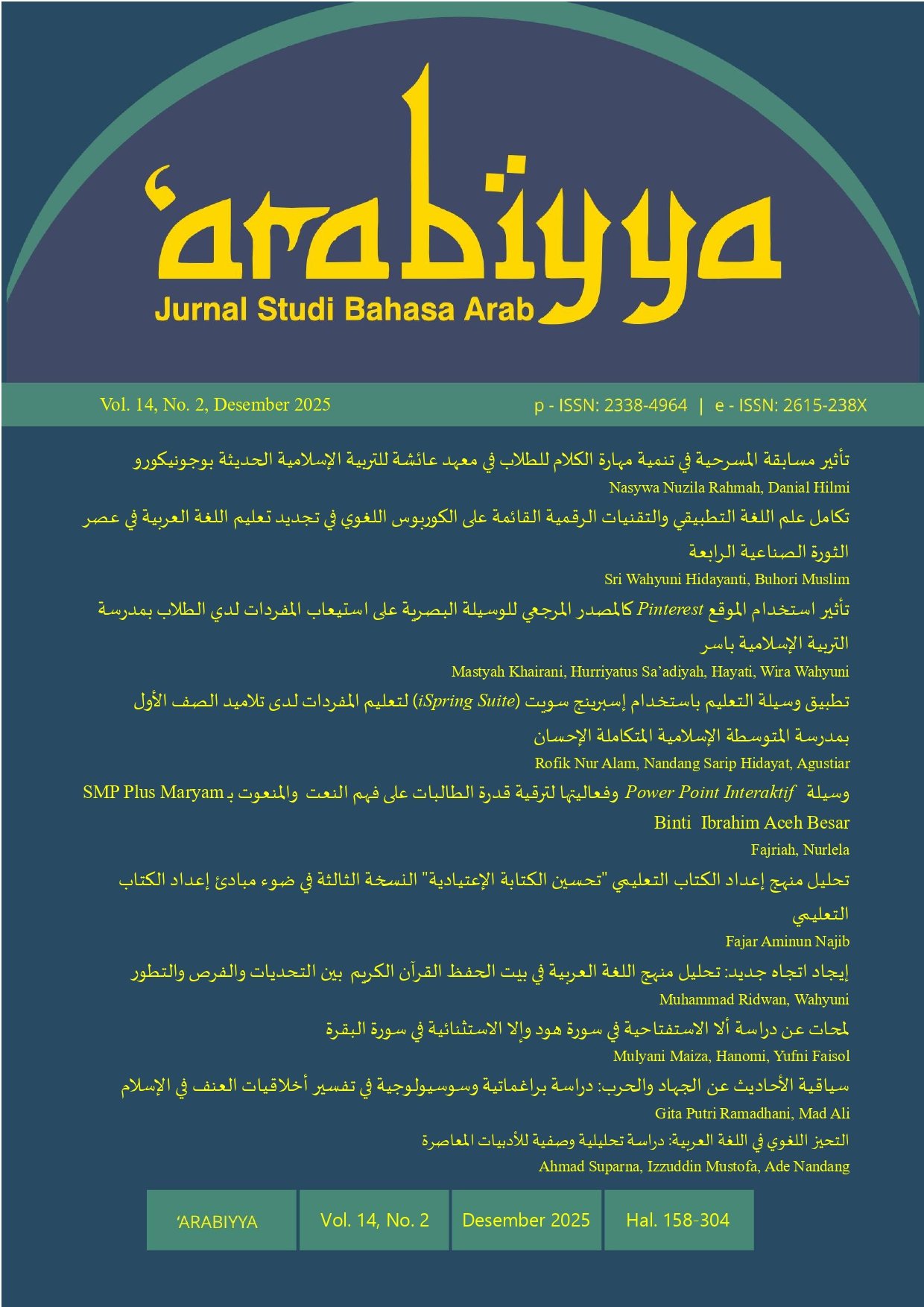
سياقية الأحاديث عن الجهاد والحرب: دراسة براغماتية وسوسيولوجية في تفسير أخلاقيات العنف في الإسلام
DOI:
https://doi.org/10.47498/bvs7jq37Keywords:
Pragmatic and Sociologigal Studies, Hadith of Jihad and War, the ethics of jihadAbstract
Discourse on jihad in hadith studies often becomes distorted due to the separation of texts from their historical and pragmatic contexts, which in turn leads to the legitimation of violence and the rise of religious militancy. This study develops an integrated analytical model to restore the meaning of jihad within the framework of prophetic
ethics and communication. By combining a pragmatic speech-act approach with Berger and Luckmann’s social construction theory, this analytical framework links the communicative functions of the Prophet’s sayings—including illocutionary types, linguistic conditions, implicatures, asbāb al-wurūd, and the context of defensive
warfare—with the social construction of hadith meaning through externalization, objectivation, and internalization. Three key hadiths are examined: umirtu an uqātila an-nās, al-harb khud‘ah, and the prohibition against killing women and children. Findings reveal their directive-defensive, representative–commissive, and normative declarative characteristics, which affirm Islamic ethics of warfare. Sociologically, the three hadiths construct a rational, ethical, and humanistic understanding of jihad. In the digital era, literalist reception often ignores historical and communicative contexts, making contextual hadith literacy increasingly urgent. This study offers humanistic warethics principles and recommends expanding cross-madhhab hadith studies as well as
digital reception research for Islamic education and deradicalization initiatives.
References
Al-Bukhari, Muhammad bin Isma’il. 1429. Al-Jami’ Al-Shahih Li Al-Bukhari. Riyadh.
Al-Mawardi, Abul-Hassan. 1058. “Al-Ahkam as-Sultaniyyah.” United Kingdom: Ta-Ha Publisher.
An-Nawawi, Imam. 2011. Syarah Shahih Muslim (Jilid 11). Jakarta: Darus Sunnah.
Azid, Muhammad Adam Abd, Ibrahim Adham Mohd Rokhibi, Mohd Farhan Md Ariffin, Muhammad Ikhlas Rosele, and Mohammad Fahmi Abdul Hamid. 2022. “THE TRAJECTORY OF THE JIHAD DISCOURSE IN MALAY WORLD An Analysis on the Baḥr Al-Mādhī by Muḥammad Idrīs Al-Marbawī.” Al-Jami’ah 60 (1): 265–86. https://doi.org/10.14421/AJIS.2022.601.265-286.
Hajar, Ahmad bin Ali bin. 1991. Fathul Baari. Pustaka Azzam. https://id.wikipedia.org/wiki/Fathul_Bari.
Hammam, and Rizwanur Rahman. 2020. “Searching Meaning of Jihad for Indonesian Muslim in the Post Reformed Era of Indonesian Polity.” Religia 23 (1): 2–11.
Hasbillah, Ahmad ’Ubaydi. 2023. “THE MESSAGE OF PEACE IN THE HADITH OF THE COMMAND FOR WARFARE ‘UMIRTU AN UQĀTIL AL-NĀS’: An Analysis of the Science of Wurūd Al-Hadīṡ.” Nabawi: Journal of Hadith Studies 4 (2). https://doi.org/10.55987/njhs.v4i2.109.
Karimullah, Suud Sarim, Rahman Rahman, St. Rahmah, and Fawwaz Elmurtadho. 2023. “Reflections of Prophetic Values on Strengthening Da’wah in the Digitalisation Era.” Mawa Izh Jurnal Dakwah Dan Pengembangan Sosial Kemanusiaan 14 (2): 31–51. https://doi.org/10.32923/maw.v14i2.3279.
Mostfa, Ali. 2021. “Violence and Jihad in Islam: From the War of Words to the Clashes of Definitions.” Religions 12 (11). https://doi.org/10.3390/rel12110966.
Musyafiq, Ahmad. 2023. “The Impact of Al-Albānī’S Revolutionary Approach To Hadith on Islamic Militancy in Indonesia.” Al-Jami’ah 61 (1): 81–105. https://doi.org/10.14421/ajis.2023.611.81-105.
Rusdi, Muhammad, Vanesia Amelia Sebayang, Syukur Kholil, and Abdi Mubarak Syam. 2024. “Islam and the Ethics of War: Deconstructing Jihad through the Principle of Humanism in Theological Discourses.” Pharos Journal of Theology 105 (5): 1–13. https://doi.org/10.46222/pharosjot.105.57.
Searle, John R. 1975. Expression and Meaning: Studies in the Theory of Speech Acts. Cambridge University Press. https://doi.org/https://doi.org/https://doi.org/10.1017/CBO9780511609213.
Sugihartati, Suyanto, and Hidayat. 2020. “Channelization Strategies of Radicalism Among Muslim University Students in Indonesia.” Journal of Indonesian Islam 2 (14). https://doi.org/10.15642/JIIS.2020.14.2.309-334.
Wahab, Abdul Jamil, Azwar Aswin, M. Fakhruddin, and Siti Atieqoh. 2024. “Deradicalization Programs in Indonesia: Perspectives of Former Terrorist Convicts.” Qudus International Journal of Islamic Studies 12 (1): 75–118. https://doi.org/10.21043/qijis.v12i1.22931.
Wasman, Mesraini, and Suwendi. 2023. “A CRITICAL APPROACH TO PROPHETIC TRADITIONS: Contextual Criticism in Understanding Hadith.” Al-Jami’ah 61 (1): 1–17. https://doi.org/10.14421/ajis.2023.611.1-17.
Downloads
Published
Issue
Section
License
Copyright (c) 2026 'ARABIYYA: JURNAL STUDI BAHASA ARAB

This work is licensed under a Creative Commons Attribution-NonCommercial-ShareAlike 4.0 International License.