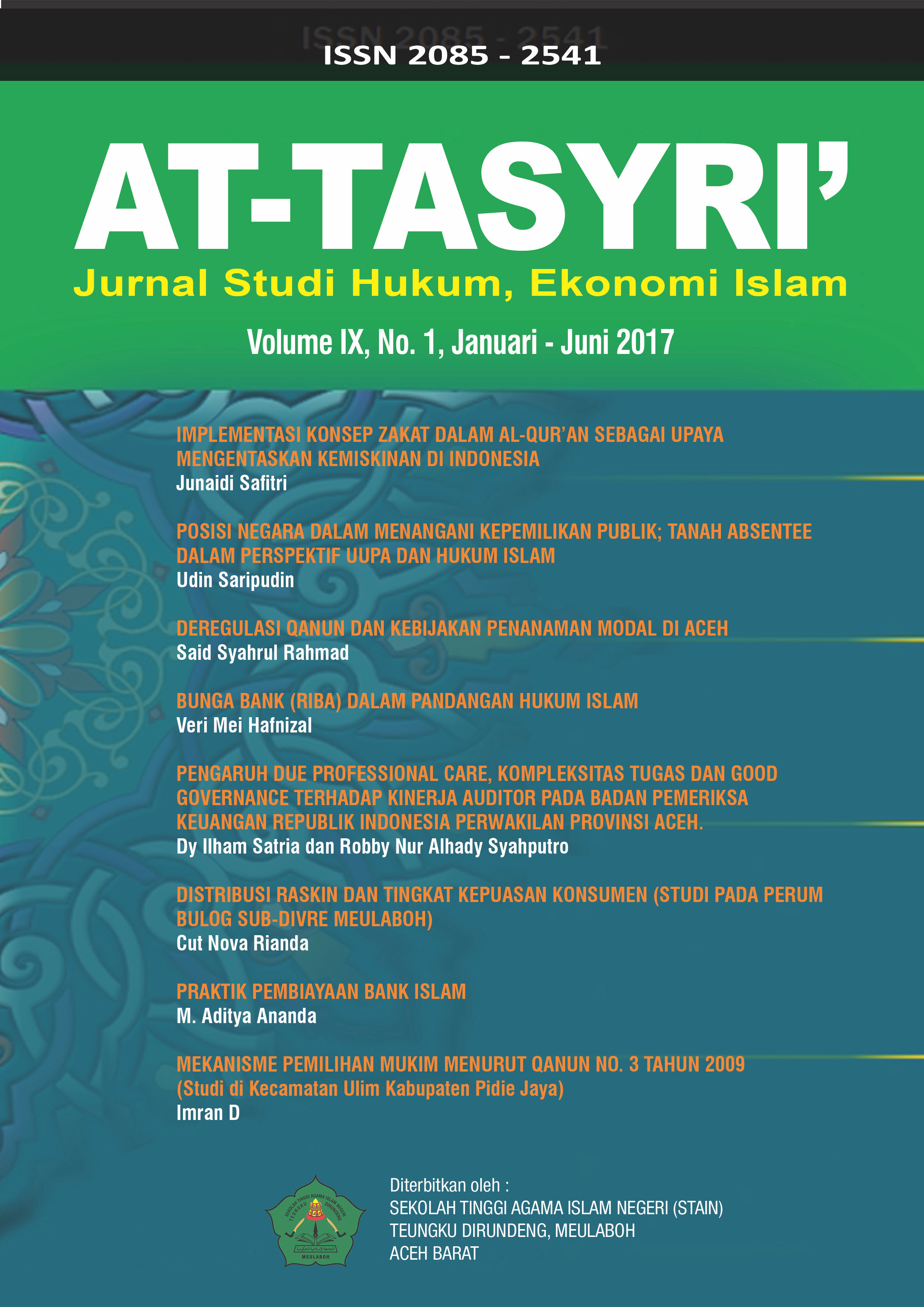
Distribusi Raskin dan Tingkat Kepuasan Konsumen (Studi Pada Perum BULOG Sub-Divre Meulaboh)
DOI:
https://doi.org/10.47498/tasyri.v9i1.37Keywords:
Distribution, Raskin, consumer satisfactionAbstract
Distribution concept in Islam is requires evenly distribution of rights; wealth must be managed and distributed to the beneficiary, should not be concentrated only on the distribution of certain groups. Practically in Meulaboh, Raskin distribution assumed not to targeted, low quality, even there are certain groups who mastered, it will cause an imbalance. Therefore, this study sought to describe about the implementation of the distribution of Raskin, Raskin recipient satisfaction and analysis based on the concept of distribution and al-maslahah in Islam. This study is a field study conducted in the community and Bulog Sub-Division Meulaboh with mixed method approach. Data collection through questionnaires, interviews, observation and documentation. Quantitative data is processed with SPSS and qualitative data analyzed with data reduction, data presentation and verification of data in order to interpret them using the theory of distribution and theory of al-maslahah. The results showed that the implementation of the distribution of Raskin 64.09% according to the rules and 59.09% of people are satisfied. The influence of the implementation of the distribution of the Raskin beneficiary satisfaction is at 20.3%. Raskin distribution on concept of Islam is a government assistance, right for the poor, if accepted by the people who are not poor that means there has been a right decision that is not in accordance with the Shari’ah. al-Maslahah concept as maqa>sid syari’ah there are two harm, namely: (a) Eliminate al-maslahah, eliminate benefits for poor people who should receive Raskin
rice. (b) Bringing harm, reduced availability of rice for the poor people
Downloads
Downloads
Published
Issue
Section
License
- The right to publish all information contained on this journal’s website is held by the editorial board with the authors’ consent. The journal’s management will uphold the authors’ moral rights.
- The formal legal provisions governing access to all information and articles contained on this journal’s website are based on the terms of the Creative Commons Attribution License (CC BY-SA 4.0) licence, which means that information and articles from the AT-TASYRI’ Journal may only be distributed to third parties, with the author’s permission, for non-commercial purposes, provided that the original form is not altered.
- Every issue of the AT-TASYRI’ Journal, whether in print or electronic form, is open access for educational, research and library purposes. Beyond these purposes, the publisher or journal management accepts no liability for any copyright infringements committed by readers or users.