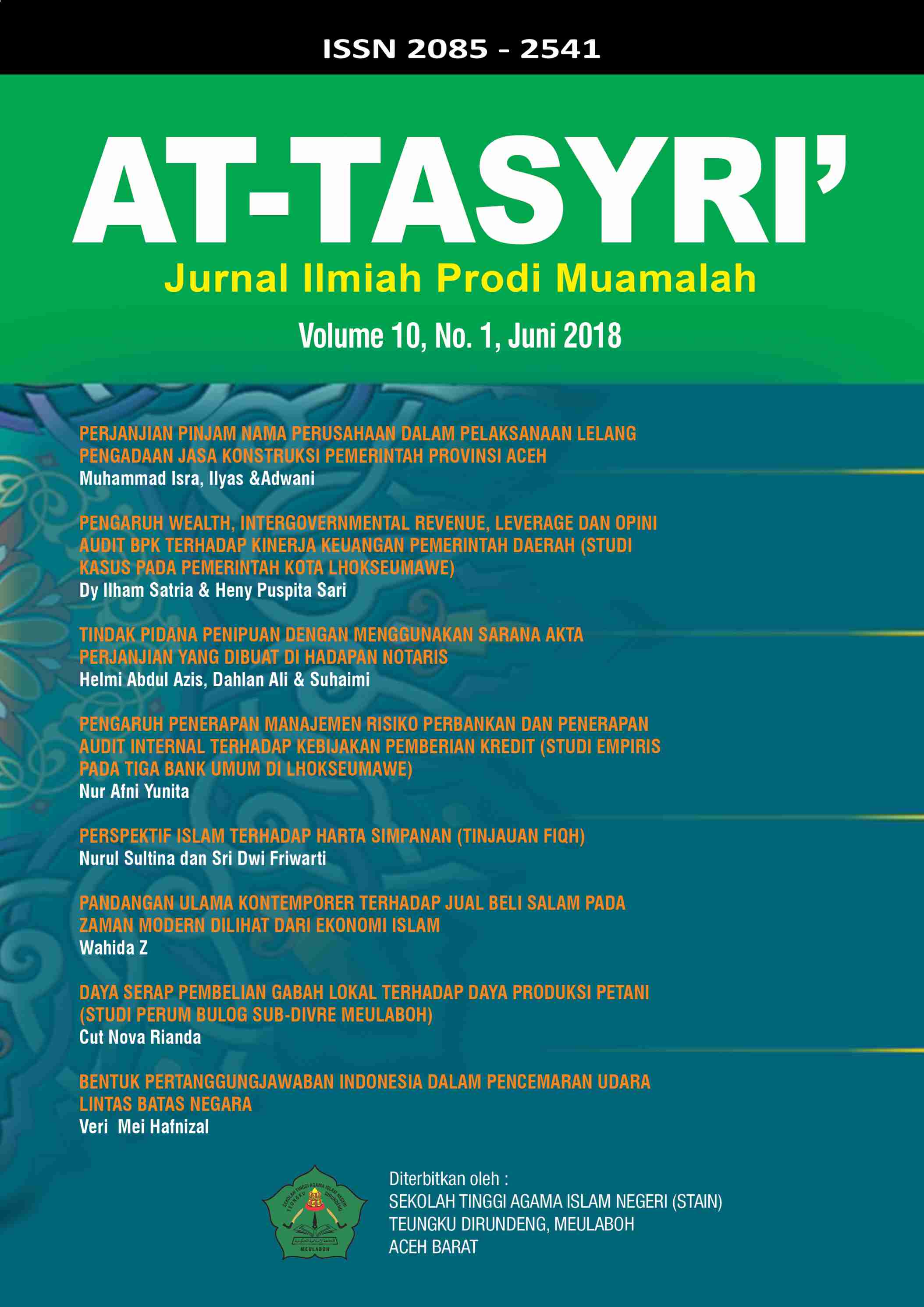
Perspektif Islam Terhadap Harta Simpanan (Tinjauan Fiqh)
DOI:
https://doi.org/10.47498/tasyri.v10i1.132Keywords:
Fiqhi Analysis, DepositsAbstract
Treasure is a human need in living the world, but not a few people who are competing to multiply the treasures, even people who are preoccupied by treasuressuch as abandoning religious dutiesbecause of neglecting to look for the treasure.Treasure is a core need in life where man will not be separated from it. The treasures of Islam are essentially belonging to Allah SWT. Then God has given it to man to take possession of the treasure. The Specificity of the owner
of an item according to syarakto act freely aims to take its benefits as long as there is no syar’i barrier. In Islam, deposit isjustified as long as not aimed to disobedience or boasting of wealth and abandonment of the remembrance of Allah. In Islamic law, the depositor is sacrificed to keep the property well, that is keeping the property so that it is not taken by others with no rights and keep the property from somethingthat are prohibited by religion. And also the depositors (owner)obliged to pay zakat from the property which he keeps every year and uses his treasures for the needs of the people when the people need help from it.
Downloads
Downloads
Published
Issue
Section
License
- The right to publish all information contained on this journal’s website is held by the editorial board with the authors’ consent. The journal’s management will uphold the authors’ moral rights.
- The formal legal provisions governing access to all information and articles contained on this journal’s website are based on the terms of the Creative Commons Attribution License (CC BY-SA 4.0) licence, which means that information and articles from the AT-TASYRI’ Journal may only be distributed to third parties, with the author’s permission, for non-commercial purposes, provided that the original form is not altered.
- Every issue of the AT-TASYRI’ Journal, whether in print or electronic form, is open access for educational, research and library purposes. Beyond these purposes, the publisher or journal management accepts no liability for any copyright infringements committed by readers or users.